
NSE chief says they're ready; positive feedback to Sebi draft.

India's equity markets may have expanded rapidly, but initial public offerings (IPOs) are increasingly becoming exit vehicles for early investors rather than as engines for raising long-term capital, a shift that undermines the spirit of public markets, Chief Economic Advisor V Anantha Nageswaran warned on Monday at a CII event.

Mutual funds (MFs) have lined up information technology (IT) funds, indicating that technology stocks are back on fund managers' radar after a hiatus. Over the past 18 months, stock prices for companies in the software space have either corrected or remained subdued. Fund houses have launched five IT-based sectoral funds in the past three months, with three of them taking the passive route.

Five companies have submitted resolution plans for Jaiprakash Associates Ltd (JAL), the flagship company of the beleaguered Jaypee group, the company has said in a stock exchange filing. The Adani group, Vedanta, Jindal Steel & Power, Dalmia Bharat, and PSP Projects are the final bidders and the offers range from Rs 10,000 crore to Rs 11,000 crore, said a source close to the development.

Among the Sensex firms, Bharat Electronics Ltd, Mahindra & Mahindra, Adani Ports, HCL Technologies, Eternal, Infosys, Bharti Airtel, Sun Pharmaceuticals, Larsen & Toubro, Hindustan Unilever and UltraTech Cement were the gainers. Bajaj Finance, Tata Motors Passenger Vehicles, Kotak Mahindra Bank, PowerGrid and Tata Steel were among the laggards.

The CBI on Friday questioned former CEO of National Stock Exchange (NSE) Chitra Ramkrishna in view of fresh facts emerging in connection with its ongoing probe into the alleged abuse of co-location facility in the NSE, officials said. The agency has also opened look out circulars against Ramkrishna, another former CEO Ravi Narain and former COO Anand Subramanian to prevent them from leaving the country. The central probe agency had booked a owner and promoter of Delhi-based OPG Securities Pvt. Ltd, Sanjay Gupta and other in connection with alleged abuse of NSE co-location facility to make gains by getting early access to the stock market, they said.

State Bank of India (SBI) and Housing Development Finance Corporation (HDFC) will see maximum inflows from passive trackers on account of the quarterly rebalancing exercise of the National Stock Exchange Nifty Bank Index. IndusInd Bank and AU Small Finance Bank could see maximum outflows. The rejig of the Nifty CPSE Index will result in inflows in Oil and Natural Gas Corporation, NTPC, and Coal India and maximum outflows in Bharat Electronics, according to Brian Freitas, a New Zealand-based analyst with Periscope Analytics.

The National Stock Exchange (NSE) on Friday warned investors not to fall prey to investment plans with guaranteed returns offered by Suraj Mourya associated with "Aimers Trader". The exchange pointed out that these entities are not registered either as a member or authorised person of any registered member of the NSE. The cautionary statement comes after the NSE noticed that Suraj Mourya associated with Aimers Trader was offering to handle trading accounts of investors by asking them to share their user identification (user ID) and password.

Vedanta, a conglomerate in mining and metals, has seen a surge in its share price on the back of multiple triggers. Its demerger appears to be on track, a strong non-ferrous commodity cycle is boosting margins, and silver bulls are interested in Hindustan Zinc, its subsidiary.

Market experts predict that the equity markets are likely to remain volatile for the rest of the year.

Nearly 90 per cent of the stocks comprising the National Stock Exchange Nifty 500 Index and 49 of the 50 stocks that make up the Nifty50 are trading above their respective 200-day moving averages (DMAs). The 200-DMA is considered one of the most relevant trend indicators by investors and traders. They believe that stocks and indices trading above this key level exhibit strength and are likely to rally, while those trading below this level are viewed as bearish, with the stock/index expected to see a selloff.

Sebi has asked stock exchanges and other market participants to remain watchful of funds and entities with Iranian links, as the global inter-governmental agency FATF continues to classify Iran as one of the 'high-risk and non-cooperative jurisdictions' with respect to money laundering and terror financing activities.

In total, BSE would shift as many as 40 securities to the trade-for-trade category or 'T' Group while NSE would transfer 18 scrips to the segment on its platform, as per separate notices issued by both the bourses.

Most market analysts are expecting the momentum to shift towards 'quality' and 'growth' stocks in 2024 after the outperformance of 'value' stocks over the past three years. 'Value' stocks are generally well-established companies with steady profits that are trading at a discount to what they are intrinsically worth. Companies in sectors such as commodities, industrials, commercial vehicles and public sector units (PSUs) fall in this bracket.

Shares of One97 Communications (OCL), which provides financial services under the brand 'Paytm', and has a banking arm Paytm Payments Bank (PPBL), hit the 5 per cent upper circuit at Rs 428.10 on the National Stock Exchange (NSE) in Monday's (February 26) intraday trade. The up move in the stock on Monday came after the Reserve Bank of India (RBI) asked the National Payments Corporation of India (NPCI), in post stock market hours, to look into the possibility of migrating PPBL customers, using the UPI handle '@paytm', to four-to-five other banks.

The Securities and Exchange Board of India (Sebi) is mulling changes to the 'fit & proper' criteria for market infrastructure institutions (MIIs), such as stock exchanges, in a bid to segregate the role of an individual from the entity, said sources. Under the current framework, wrongdoing by senior personnel could lead to a debarment of the MIIs such as stock exchanges, depository participants and clearing members-with quite a few such instances in the past. Additionally, Sebi is also mulling to introduce a clause through which any order passed against an MII will not affect their operations, unless it is specifically mentioned so in the order.

After a strong run in the midcap and smallcap indices, which surged 46 per cent and 43 per cent, respectively, on the National Stock Exchange (NSE) during Samvat 2080, analysts suggest that the rally in these segments may pause to catch its breath in Samvat 2081.

The National Stock Exchange listed the Dow Jones Industrial and S&P 500 on its platform last week.

'As we navigate uncertain waters, a conservative approach to largecap investing could provide a strategic advantage.'

The total number of unique investors directly investing in the stock market has surged to 80 million for the first time, with the latest 10 million additions taking place in just eight months, according to data shared by the National Stock Exchange (NSE), the country's largest bourse. "The 80 million unique PAN (permanent account number) investors correspond approximately to around 50 million unique households in India amounting to around 17 per cent households directly investing in the Indian stock market via NSE's extensive nationwide network of trading members," said the exchange. In 2021, the number of domestic households were pegged at 300 million.

The Union Budget 2025-26, while promising a new framework for smoother mergers and acquisitions (M&As), has plugged a major loophole on carry-forward losses for a total of eight assessment years between amalgamating company and amalgamated company from the date of loss instead of date of the merger. For all mergers effected on or after April 1, 2025, the losses can be carried forward only for the residuary period (counting from the date of loss).

The National Company Law Tribunal (NCLT) on Thursday allowed the merger of Zee Entertainment Enterprises Ltd and Culver Max Entertainment (earlier known as Sony Pictures Networks India). This order by the Mumbai bench, headed by H V Subba Rao and Madhu Sinha, will pave the way for the creation of a $10-billion media company, the biggest in the country. The tribunal also dismissed all objections regarding the merger.

The Securities and Exchange Board of India's (Sebi's) six-step plan to curb retail participation in speculative index derivatives may lead to a substantial drop in volumes - potentially by 30-40 per cent. These measures aim to reduce excessive speculation in the futures and options (F&O) segment, where daily turnover often exceeds Rs 500 trillion and retail investors end up on the losing side of the trade more often. Sebi has decided to increase the contract size from Rs 5 lakh to Rs 15 lakh, raising margin requirements and mandating the upfront collection of option premiums from buyers.

The upper market capitalisation (mcap) threshold for midcap and smallcap stocks in the mutual fund (MF) industry's revised list of stocks, to be announced this month, is set to see the second-highest yearly rise in the past five years. The list was first announced in 2018, and it has been revised every six months since then. According to estimates released by Nuvama Alternative & Quantitative Research, the upper threshold for the midcap and smallcap universes could come in at Rs 66,700 crore and Rs 21,900 crore in the next list.

The Nifty Options would add to SGX's suite of Asian equity derivatives, which include SGX S&P CNX Nifty futures, the dominant Indian product for international participants.
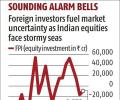
Foreign portfolio investors (FPIs) have withdrawn Rs 25,305 crore from domestic markets since September. FPIs were net sellers in the first two months of 2023, but from March to August, they purchased equities worth Rs 1.7 trillion. This selling trend has caused the National Stock Exchange Nifty Index to decline by 3.2 per cent from its September highs. FPI selling initially began in September as profit-taking but intensified due to rising US bond yields and uncertainty regarding the rate hike trajectory.

Madhabi Puri Buch, the first female chairperson of Sebi, doesn't plan to rest on her laurels in her third and final year in office and has set out an ambitious goal, such as moving towards a same-day and instantaneous settlement cycle for the secondary market.

Capital markets regulator Sebi on Thursday sent a notice to NSE's former chief Ravi Narain, asking him to pay Rs 2.06 crore in a case related to governance lapses at the stock exchange, and warned of arrest and attachment of assets and bank accounts if he fails to make the payment within 15 days. The notice came after Narain failed to pay the fine imposed on him by SEBI (Securities and Exchange Board of India). The regulator, through an order passed on February 11, levied a fine of Rs 2 crore on Narain in the matter of governance issues over the appointment of the chief strategic officer at the stock exchange in 2013.
As part of efforts to develop the corporate bond market, trading platforms for the fledgling instruments are expected to be operational from July at the Bombay Stock Exchange and the National Stock Exchange.

While a little more than 140 penny stocks have doubled in value, 555 have given negative returns in the past year. Of these, 84 shed more than half their value.
The US market has been a standout performer this year, with the benchmark Standard and Poor's 500 (or simply the S&P 500) gaining over 16 per cent during the first half of calendar year 2023 (CY23) in what was its best first-half show since 2019. By comparison, India's National Stock Exchange Nifty 500 has gained 6.4 per cent. On the surface, it appears that the US markets have done exceedingly well. However, a deeper analysis reveals the gains in the domestic market to be more well-spread.

From the Sensex firms, Tata Motors jumped the most by 5.54 per cent, followed by Kotak Mahindra Bank, Trent, Sun Pharma, Axis Bank, and ICICI Bank. However, Bajaj Finance, State Bank of India, UltraTech Cement and Tata Steel were among the laggards.

The market share of discount brokers - such as Zerodha, Groww, Upstox, and Angel One - has grown fivefold in five financial years, with more than half of the National Stock Exchange's (NSE's) active client trading coming through them, reveals a report by CLSA. For the first 11 months of 2022-23, discount brokers held sway over 57 per cent of active clients, up from 11 per cent in 2017-18. Moreover, the number of active clients on the NSE with discount brokers has grown from just 1 million to 19 million during this period. Active traders are those who have traded at least once in 12 months.
Leading stock exchange NSE has tweaked the constituents of its major indices with Adani Group's two companies -- Adani Wilmar and Adani Power -- all set to make their way into some of the Nifty indices from March 31, 2023. Adani Wilmar will be part of Nifty Next 50 and Nifty 100 indices, while Adani Power will be included in Nifty 500, Nifty 200, Nifty Midcap 100, Nifty Midcap 150, Nifty LargeMidcap 250, and Nifty Midsmallcap 400 indices. All the changes in the indices will be effective from March 31 this year, the exchange said in a late night statement on Friday.

Among the Sensex firms, JSW Steel, Tata Steel, Tech Mahindra, Infosys, Wipro, Tata Consultancy Services, Nestle, HCL Technologies, HDFC Bank and Maruti were the major laggards. IndusInd Bank, ITC, Bharti Airtel and State Bank of India were among the winners.

The CBI has arrested Sanjay Gupta, owner and promoter of Delhi based OPG Securities Pvt. Ltd, in connection with the NSE co-location scam in which brokers allegedly abused the facility to make gains by getting early access to the stock market, officials said on Wednesday. The agency has already arrested Chitra Ramkrishna, former CEO and managing director of NSE and Anand Subramanian, former group operating officer of the market, they said. Gupta was arrested on Tuesday night, four years after the agency had registered the FIR in the Co-location scam case against him and his company.

According to the new proposals, resident promoters or a foreign promoter from a FATF jurisdiction can set up a market infrastructure institution.
Cairn India Ltd, which listed on the National Stock Exchange at Rs 152 on Tuesday, said it will invest $1.5 billion in exploration and development activities in India over the next three years.

If Beijing succeeds in this multipronged effort to challenge the current dominant power, it will have not just economic but political and security consequences. There is no let-up in the South China Sea nor any de-escalation moves on the India-China border. This portends to ominous signalling from Beijing, observes China expert Srikanth Kondapalli.
